



Hard Sided Hyperbaric Oxygen Therapy (HBOT) in Denver - 2.0 ATA

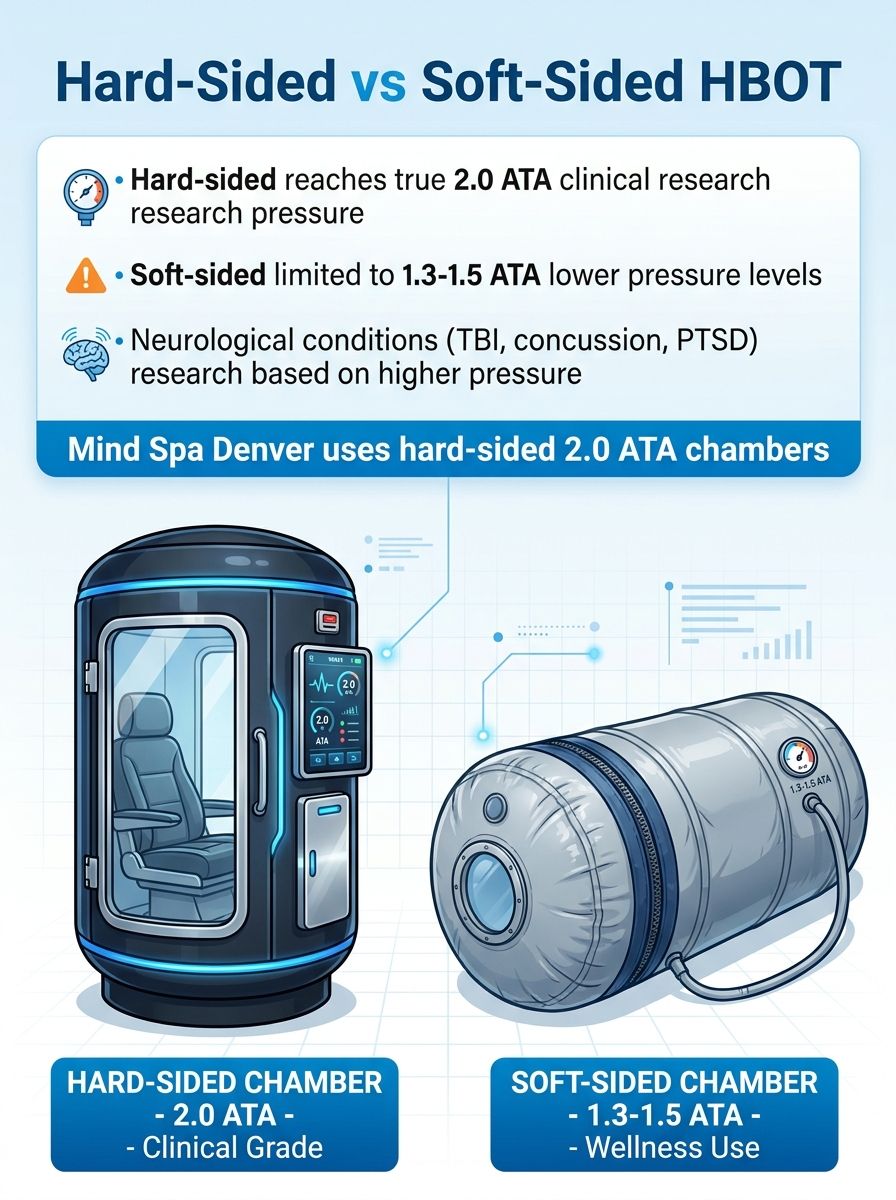
Hyperbaric Oxygen Therapy (HBOT) is a medical treatment where you breathe concentrated oxygen inside a pressurized chamber, allowing your bloodstream and tissues to receive far more oxygen than under normal conditions. Mind Spa Denver uses a true hard-sided (hard shell) hyperbaric chamber that reaches a clinical 2.0 ATA — significantly higher pressure than the soft-sided, inflatable chambers (typically limited to 1.3–1.5 ATA) found at most wellness studios. The hard-sided design is what allows the higher pressure used in clinical HBOT research for brain recovery, TBI, concussion, and PTSD.
How Does It Work?
When you breathe pure oxygen under pressure, both your red blood cells and plasma carry significantly more oxygen to areas affected by injury, inflammation, or impaired blood flow. This oxygen surplus can reduce neuroinflammation, stimulate stem cell production and neurogenesis, enhance mitochondrial function and ATP production, support new blood vessel growth (angiogenesis), and strengthen detoxification and immune responses involved in healing.
For patients with traumatic brain injury (TBI) or post-traumatic stress disorder (PTSD), HBOT helps restore function by accelerating the brain’s natural healing processes. Brain imaging studies even show structural and metabolic improvements in areas affected by trauma.
Who is HBOT for?
HBOT at Mind Spa Denver is designed for people who have not responded fully to conventional treatments for traumatic brain injury (TBI), post‑traumatic stress disorder (PTSD), concussion and post‑concussion syndrome, and depression or anxiety related to brain injury or chronic stress. It is particularly relevant for veterans, first responders, and athletes, as well as anyone with lingering cognitive, emotional, or physical symptoms after brain trauma.
What Is the Patient Experience Like?
Each HBOT session takes place in a comfortable, 2.0 ATA chamber where you sit back, relax, and breathe normally while the chamber gradually pressurizes. Sessions last about 60 minutes, are typically scheduled in a series of 20–40 treatments depending on clinical needs, and are generally well‑tolerated with only mild, infrequent side effects such as temporary ear pressure or fatigue.
What results can patients expect?
Over a decade of clinical research suggests that HBOT can contribute to improved memory, focus, mood, sleep, and emotional regulation, while reducing anxiety, depression, and other persistent post‑injury symptoms. When completed as a full course and combined with complementary treatments like TMS, ketamine infusion therapy, and psychotherapy, many patients report substantial symptom relief within a few weeks and a lower risk of long‑term disability after TBI.
What results can patients expect?
Over a decade of clinical research suggests that HBOT can contribute to improved memory, focus, mood, sleep, and emotional regulation, while reducing anxiety, depression, and other persistent post‑injury symptoms. When completed as a full course and combined with complementary treatments like TMS, ketamine infusion therapy, and psychotherapy, many patients report substantial symptom relief within a few weeks and a lower risk of long‑term disability after TBI.
Patients who complete a full course of HBOT, especially when combined with TMS, ketamine infusion therapy, and psychotherapy, patients often report full symptom remission within 2–3 weeks. For many, it’s the breakthrough they’ve been waiting for.
How to get started
If you are ready to explore a science‑backed, integrative approach to healing your brain and reclaiming your life, Mind Spa Denver’s team can guide you through whether HBOT is appropriate for your specific history and goals. Complete our secure new patient forms, and a member of the team will reach out to schedule a personalized consultation and treatment plan.
Start Your Recovery Today
If you're ready to explore a science-backed, integrative approach to healing your brain and reclaiming your life, Mind Spa Denver is here to help.
👉 Click here and fill out our new patient forms, a member of our team will reach out to schedule your personalized consultation.
Selected Clinical References:
- Harch & Fogarty, Medical Gas Research, 2018
- Boussi-Gross et al., PLoS ONE, 2013
- Hadanny & Efrati, Expert Rev Neurother, 2016
- Sackheim et al., Am J Psychiatry, 2022
- Tal et al., Frontiers in Psychology, 2021
Hyperbaric Oxygen Therapy FAQ
1. What is Hyperbaric Oxygen Therapy?
Hyperbaric Oxygen Therapy, often called HBOT, is a treatment that helps the body absorb more oxygen under pressure. During treatment, you relax inside a pressurized chamber while breathing oxygen. Because the chamber is pressurized, oxygen can dissolve more deeply into the bloodstream and reach tissues that may be inflamed, injured, oxygen-starved, or slow to heal.
At Mind Spa, HBOT is used as a supportive therapy for brain health, neurological recovery, and whole-body healing. The goal is simple: give the body more oxygen in an environment where that oxygen can be delivered more effectively.
2. How does HBOT help the body heal?
Healing requires oxygen. When tissue is injured, inflamed, infected, or poorly supplied with blood, it often does not get the oxygen it needs to repair itself. HBOT increases oxygen availability in the blood and tissues, which may support wound repair, reduce inflammation, improve cellular energy production, and stimulate repair pathways.
This is why HBOT has been studied for wound healing, diabetic foot ulcers, radiation injury, traumatic injuries, and neurological conditions. It is not a magic switch, but it can be a powerful tool when the body needs more oxygen to repair damaged tissue.
3. What conditions is HBOT commonly used for?
HBOT is best established for certain medical conditions involving tissue injury, poor oxygen delivery, and wound healing. These include selected diabetic foot ulcers, radiation tissue injury, compromised skin grafts or flaps, some severe infections, and certain nonhealing wounds.
HBOT is also being studied for brain-related conditions such as traumatic brain injury, concussion, post-concussion symptoms, PTSD, depression, anxiety, and cognitive dysfunction. These neurological and mental health uses are promising, but they are generally considered off-label and should be discussed honestly with a qualified clinician.
4. Is HBOT approved for wound healing?
Yes. HBOT is an accepted medical treatment for specific wound-healing conditions, especially when poor oxygen delivery is part of the problem. It is most often used as an add-on therapy, meaning it works alongside standard wound care rather than replacing it.
For wound healing, HBOT may be considered when a wound is not healing as expected despite appropriate care. This is especially relevant for certain diabetic foot wounds, radiation-related tissue damage, and compromised tissue where oxygen delivery is impaired.
5. Can HBOT help diabetic foot ulcers?
HBOT may help selected diabetic foot ulcers, especially more serious wounds that are not healing with standard care. The reason is straightforward: diabetic wounds often have poor blood flow, inflammation, infection risk, and impaired tissue repair. HBOT can increase oxygen delivery to the wound environment and may support healing.
Patients should understand that HBOT is not a stand-alone treatment for diabetic foot ulcers. Good wound care still matters. That includes offloading pressure, controlling blood sugar, treating infection, improving circulation when possible, debridement, nutrition, and regular wound monitoring.
6. Can HBOT help prevent amputation?
In some patients with severe diabetic foot ulcers, HBOT may help reduce the risk of major amputation when it is used with high-quality wound care. This does not mean HBOT can save every limb, but it can serve as a powerful adjunctive therapy.
The patients most likely to benefit are usually those with wounds that meet specific clinical criteria, especially deeper or more advanced ulcers that have not improved with standard treatment.
7. Does HBOT replace regular wound care?
No. HBOT does not replace wound care. It supports wound care.
A good way to think about HBOT is as a biological amplifier. It can help deliver more oxygen into damaged tissue, but the wound still needs proper cleaning, pressure relief, infection control, blood-flow assessment, glucose control, nutrition, and medical supervision.
For wound healing, HBOT works best when it is part of a complete treatment plan.
8. How many HBOT sessions are usually needed?
The number of HBOT sessions depends on the condition being treated, the severity of the problem, and how the patient responds.
For wound healing, treatment plans often involve a larger number of sessions, commonly several treatments per week over multiple weeks. Some wound-healing protocols use 30 to 40 sessions or more.
For brain health, concussion recovery, TBI symptoms, PTSD, or neurological support, Mind Spa Denver’s HBOT page describes treatment courses that commonly range from 20 to 40 sessions, depending on clinical need.
9. What happens during an HBOT session?
During an HBOT session at Mind Spa Denver, you relax inside a roomy and comfortable pressurized chamber while the chamber gradually increases pressure. Mind Spa's hyperbaric chambers dive as deep as 2.0 ATA (atmospheres absolute) , with sessions lasting 60-90 minutes.
Most patients feel pressure in their ears during the beginning and end of the session, similar to what happens during airplane takeoff or landing. Once the chamber reaches treatment pressure, many patients rest quietly, meditate, or simply relax.
10. Is HBOT painful?
HBOT is generally not painful. The most common sensation is ear pressure as the chamber pressurizes or depressurizes. This can usually be managed by swallowing, yawning, or using other ear-clearing techniques.
Some patients feel tired afterward. Others feel calm or mentally clear. A small number of people may feel anxious in the chamber, especially if they are prone to claustrophobia. If you are prone to claustrophobia please notify the HBOT tech and your provider prior to entering the chamber.
11. What are the risks or side effects of HBOT?
HBOT is generally well tolerated when patients are properly screened and treatments are supervised. The most common side effects include temporary ear pressure, sinus pressure, fatigue, and temporary changes in vision.
Less common but more serious risks can include ear injury, sinus injury, oxygen toxicity, seizure, lung barotrauma, or worsening claustrophobia. These risks are uncommon, but they are real. That is why HBOT always begins with medical screening and is delivered in a safe clinical environment.
12. Who should not do HBOT?
HBOT is not appropriate for everyone. Patients are always screened before starting treatment.
People with an untreated pneumothorax should not receive HBOT. Extra caution may also be needed for patients with certain lung conditions, active ear or sinus problems, uncontrolled seizure risk, severe claustrophobia, certain implanted devices, or specific chemotherapy medications.
The safest approach is always to review your medical history, medications, implants, lung health, ear and sinus history, and neurological history before treatment begins.
13. Is HBOT covered by insurance?
Insurance coverage depends on the diagnosis.
HBOT is more likely to be covered for established medical indications such as certain diabetic foot ulcers, radiation tissue injury, and other recognized wound-healing or tissue-injury conditions. Coverage usually requires documentation that the condition meets specific medical criteria.
HBOT for TBI, concussion, PTSD, depression, anxiety, wellness, or cognitive optimization is less likely to be covered because these uses are often considered off-label or investigational by insurers. Patients should ask the clinic to verify benefits and explain out-of-pocket costs before starting care.
14. Can HBOT help TBI or concussion symptoms?
HBOT may help some people with traumatic brain injury, concussion, or post-concussion symptoms, but the research is not settled. Some studies have reported improvements in symptoms, cognitive function, brain activity, or quality of life.
At Mind Spa Denver, HBOT is best understood as part of a broader brain-health plan. For patients with TBI, concussion symptoms, PTSD, depression, anxiety, sleep problems, headaches, or cognitive changes, HBOT may be used alongside other evidence-informed treatments and objective symptom tracking.
15. Is HBOT FDA-approved for TBI, PTSD, or depression?
HBOT is not FDA-approved as a treatment for TBI, PTSD, depression, anxiety, or post-concussion syndrome.
That does not mean HBOT has no scientific basis. Oxygen delivery, inflammation, mitochondrial function, vascular repair, and neuroplasticity are all relevant to brain recovery. It does mean that patients deserve clear, honest language. HBOT for brain and mental health conditions should be described as an off-label therapy with promising but still evolving evidence.
For patients considering HBOT for TBI, PTSD, depression, anxiety, or concussion symptoms, the best next step is a clinical evaluation. The question is not simply, “Does HBOT work?” The better question is, “Is HBOT appropriate for my condition, my goals, my medical history, and my overall treatment plan?”
16. Hard Sided Chamber Vs. Soft Sided Chamber? What's the difference between hard-sided and soft-sided HBOT?
A 2.0 ATA hard-sided chamber creates a higher-pressure treatment environment than 1.3–1.4 ATA inflatable wellness chambers, and that higher pressure proportionally increases inspired gas partial pressures. This may support greater tissue oxygen availability when oxygen is being delivered, but the final oxygen dose depends on the actual oxygen concentration delivered to the patient.
For wound healing, the clinical literature generally supports HBOT as an adjunctive therapy because it increases oxygen availability in hypoxic tissues. A Cochrane review states that HBOT has been proposed to improve oxygen supply to wounds and thereby improve healing.
However, most wound-healing evidence is not based on 1.3 ATA inflatable wellness chambers. Many clinical wound protocols use higher pressures, commonly around 2.0 ATA or above, combined with medical oxygen delivery. For example, one clinical review described diabetic wound and peripheral arterial disease patients receiving 90 minutes of oxygen at 2.0 ATA.
Research and Medical References
The following peer-reviewed studies support the discussion of Hyperbaric Oxygen Therapy (HBOT), including oxygen delivery, tissue repair, chronic wound healing, diabetic foot ulcers, HBOT safety, traumatic brain injury, post-concussion symptoms, PTSD, and neuroplasticity.
Mechanisms of Action, Oxygen Delivery, and Tissue Repair
Thom, S. R. (2011). Hyperbaric oxygen: Its mechanisms and efficacy. Plastic and Reconstructive Surgery, 127(Suppl. 1), 131S-141S. https://doi.org/10.1097/PRS.0b013e3181fbe2bf
Supports: HBOT mechanisms, oxygen-mediated signaling, stem/progenitor cell effects, angiogenesis, and tissue-repair pathways.
Ortega, M. A., Fraile-Martínez, O., García-Montero, C., Callejón-Peláez, E., Sáez, M. A., Álvarez-Mon, M. A., García-Honduvilla, N., Monserrat, J., Álvarez-Mon, M., Bujan, J., & Canals, M. L. (2021). A general overview on the hyperbaric oxygen therapy: Applications, mechanisms and translational opportunities. Medicina, 57(9), 864. https://doi.org/10.3390/medicina57090864
Supports: HBOT physiology, increased oxygen availability, anti-inflammatory effects, antimicrobial effects, angiogenesis, and translational medical applications.
Hadanny, A., & Efrati, S. (2020). The hyperoxic-hypoxic paradox. Biomolecules, 10(6), 958. https://doi.org/10.3390/biom10060958
Supports: The biological concept that repeated intermittent hyperoxia may activate repair pathways commonly associated with hypoxia signaling, including mechanisms related to angiogenesis, mitochondrial function, and tissue repair.
Wound Healing and Diabetic Foot Ulcers
Hajhosseini, B., Kuehlmann, B. A., Bonham, C. A., Kamperman, K. J., & Gurtner, G. C. (2020). Hyperbaric oxygen therapy: Descriptive review of the technology and current application in chronic wounds. Plastic and Reconstructive Surgery - Global Open, 8(9), e3136. https://doi.org/10.1097/GOX.0000000000003136
Supports: HBOT technology, chronic wound care, diabetic foot ulcer application, patient selection, and limitations in the wound-care evidence base.
Sharma, R., Sharma, S. K., Mudgal, S. K., Jelly, P., & Thakur, K. (2021). Efficacy of hyperbaric oxygen therapy for diabetic foot ulcer, a systematic review and meta-analysis of controlled clinical trials. Scientific Reports, 11, 2189. https://doi.org/10.1038/s41598-021-81886-1
Supports: Evidence that adjunctive HBOT may improve complete healing and reduce major amputation risk in selected diabetic foot ulcer patients, while noting methodological limitations.
Zhang, Z., Zhang, W., Xu, Y., & Liu, D. (2022). Efficacy of hyperbaric oxygen therapy for diabetic foot ulcers: An updated systematic review and meta-analysis. Asian Journal of Surgery, 45(1), 68-78. https://doi.org/10.1016/j.asjsur.2021.07.047
Supports: Additional meta-analysis evidence that HBOT may improve healing rate, shorten healing time, and reduce major amputation risk in diabetic foot ulcer patients.
HBOT Safety and Side Effects
Heyboer, M., III, Sharma, D., Santiago, W., & McCulloch, N. (2017). Hyperbaric oxygen therapy: Side effects defined and quantified. Advances in Wound Care, 6(6), 210-224. https://doi.org/10.1089/wound.2016.0718
Supports: Patient safety language, including ear pressure, middle-ear barotrauma, sinus pressure, oxygen toxicity, temporary vision changes, seizure risk, and overall HBOT tolerability when properly supervised.
Zhang, Y., Zhou, Y., Jia, Y., Wang, T., & Meng, D. (2023). Adverse effects of hyperbaric oxygen therapy: A systematic review and meta-analysis. Frontiers in Medicine, 10, Article 1160774. https://doi.org/10.3389/fmed.2023.1160774
Supports: Balanced discussion of HBOT adverse effects, including ear discomfort, treatment-course considerations, pressure-related safety considerations, and the importance of medical screening.
Traumatic Brain Injury and Post-Concussion Symptoms
Boussi-Gross, R., Golan, H., Fishlev, G., Bechor, Y., Volkov, O., Bergan, J., Friedman, M., Hoofien, D., Shlamkovitch, N., Ben-Jacob, E., & Efrati, S. (2013). Hyperbaric oxygen therapy can improve post concussion syndrome years after mild traumatic brain injury: Randomized prospective trial. PLOS ONE, 8(11), e79995. https://doi.org/10.1371/journal.pone.0079995
Supports: Evidence that HBOT may improve cognitive function, quality of life, and brain activity in some patients with chronic mild TBI and persistent post-concussion symptoms.
Tal, S., Hadanny, A., Sasson, E., Suzin, G., & Efrati, S. (2017). Hyperbaric oxygen therapy can induce angiogenesis and regeneration of nerve fibers in traumatic brain injury patients. Frontiers in Human Neuroscience, 11, 508. https://doi.org/10.3389/fnhum.2017.00508
Supports: HBOT-related brain-repair language, including research on cerebral angiogenesis, white and gray matter microstructure, nerve-fiber integrity, and cognitive improvement in chronic TBI patients.
Harch, P. G., Andrews, S. R., Rowe, C. J., Lischka, J. R., Townsend, M. H., Yu, Q., & Mercante, D. E. (2020). Hyperbaric oxygen therapy for mild traumatic brain injury persistent postconcussion syndrome: A randomized controlled trial. Medical Gas Research, 10(1), 8-20. https://doi.org/10.4103/2045-9912.279978
Supports: Evidence suggesting HBOT may improve symptoms and cognitive function in some patients with persistent post-concussion syndrome after mild TBI.
PTSD, Veterans, and Neuroplasticity
Doenyas-Barak, K., Catalogna, M., Kutz, I., Levi, G., Hadanny, A., Tal, S., Daphna-Tekoha, S., Sasson, E., Shechter, Y., & Efrati, S. (2022). Hyperbaric oxygen therapy improves symptoms, brain’s microstructure and functionality in veterans with treatment resistant post-traumatic stress disorder: A prospective, randomized, controlled trial. PLOS ONE, 17(2), e0264161. https://doi.org/10.1371/journal.pone.0264161
Supports: Research suggesting HBOT may improve PTSD-related symptoms, brain microstructure, and brain function in veterans with treatment-resistant PTSD.
Doenyas-Barak, K., Kutz, I., Lang, E., Assouline, A., Hadanny, A., Aberg, K. C., Levi, G., Beberashvili, I., Mayo, A., & Efrati, S. (2024). Hyperbaric oxygen therapy for veterans with combat-associated posttraumatic stress disorder: A randomized, sham-controlled clinical trial. Journal of Clinical Psychiatry, 85(4), 24m15464. https://doi.org/10.4088/JCP.24m15464
Supports: Recent sham-controlled evidence evaluating HBOT for combat-associated PTSD in veterans, including PTSD symptom measures and resting-state functional MRI findings.
Andrews, S. R., & Harch, P. G. (2024). Systematic review and dosage analysis: Hyperbaric oxygen therapy efficacy in the treatment of posttraumatic stress disorder. Frontiers in Neurology, 15, Article 1360311. https://doi.org/10.3389/fneur.2024.1360311
Supports: Review-level discussion of HBOT for PTSD symptoms, including treatment dose, chamber pressure, treatment frequency, and symptom-response patterns.