


Why Does Psychiatry Test One Treatment at a Time?
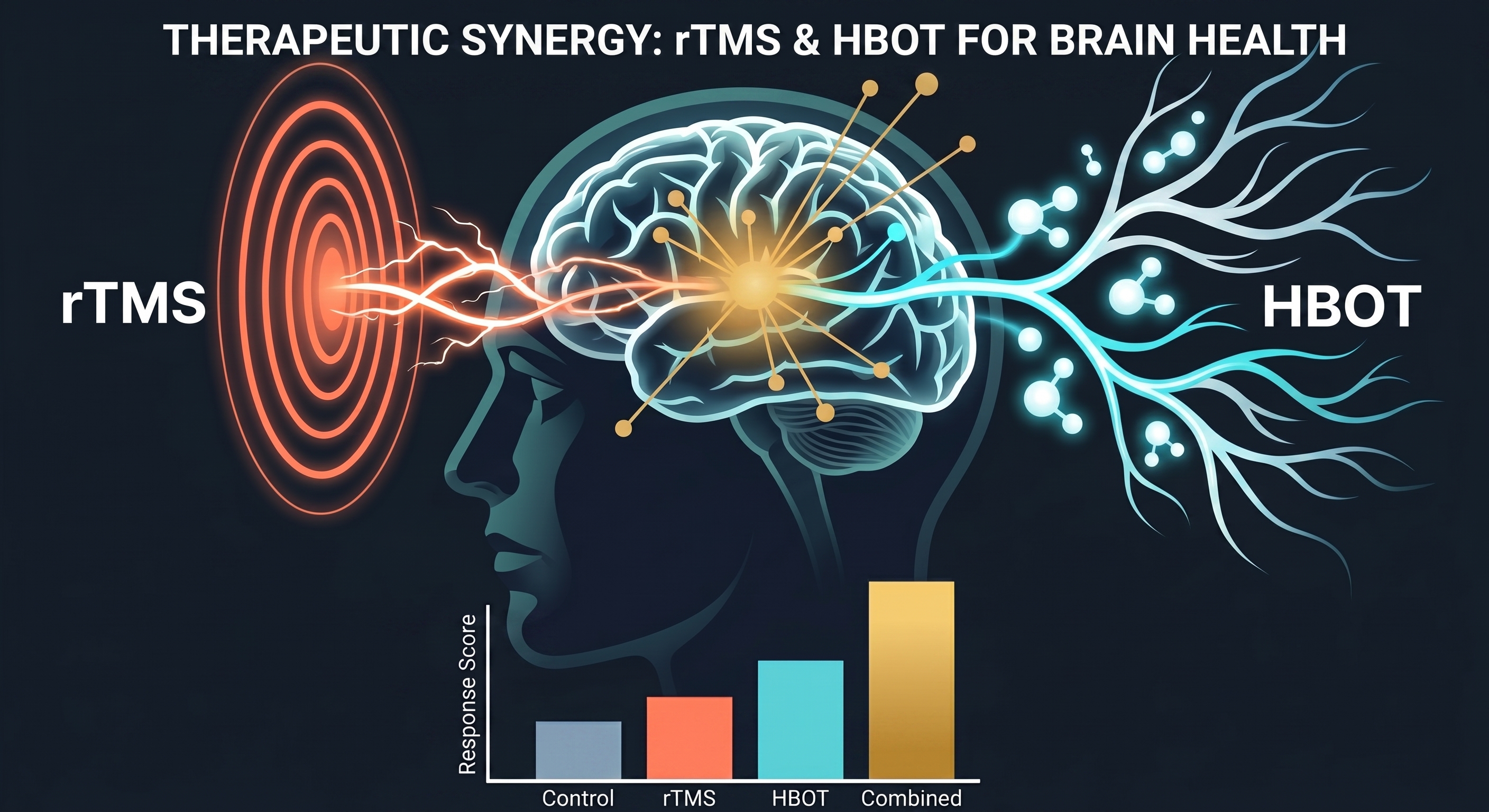
Most psychiatric trials compare one treatment against another, as if the brain picks a single winner. Two trials published in 2026 point in a different direction. One found that hyperbaric oxygen plus transcranial magnetic stimulation roughly doubled cognitive gains compared with either alone. The other found that hyperbaric oxygen raised a measurable growth signal in the blood alongside depression improvement. Both studied stroke patients, not veterans, and both are small. But together they make the case that treatments acting on different layers of the brain should be studied together, and that recovery should be measured in biology as well as symptoms.
The horse race problem
Open almost any psychiatry journal and you will find the same study design. Treatment A versus treatment B. Drug versus placebo. Device versus sham. The question is always which one wins.
That design makes sense when the treatments do the same thing. Two antidepressants that both act on serotonin can be raced fairly. But interventional psychiatry now has tools that act on completely different parts of the system. Repetitive transcranial magnetic stimulation (rTMS, a magnetic pulse delivered through the scalp to change activity in a specific brain circuit) works at the level of networks. Hyperbaric oxygen therapy (HBOT, breathing pure oxygen in a pressurized chamber) acts on tissue: blood flow, oxygen delivery, inflammation, and cell energy. Ketamine acts on glutamate signaling and the growth of new synaptic connections.
Racing those against each other is like asking whether the electrician or the plumber fixed the house. They worked on different floors of the same building. The useful question is what happens when both are on site at once.
A trial published in August 2026 asked that question directly.
The relay: hyperbaric oxygen plus rTMS after stroke
Researchers at West China Hospital randomized 72 patients with vascular cognitive impairment (thinking and memory problems caused by stroke) into four groups of 18: standard rehabilitation alone, standard care plus HBOT, standard care plus rTMS, or standard care plus both (Lin et al., Frontiers in Neurology, 2026).
The protocols were not exotic. rTMS was delivered at 10 Hz over the left dorsolateral prefrontal cortex, the same target used in depression treatment, at 2,000 pulses per session. HBOT was 2.0 atmospheres absolute with 60 minutes of oxygen per session. Both ran five days a week for three weeks. In the combined group, rTMS came first, then a 30 minute rest, then the chamber.
The primary outcome was the Montreal Cognitive Assessment (MoCA), a 30 point screening test that covers memory, attention, language, visuospatial skills, and executive function. Scores below 26 indicate impairment. Every patient started around 16 to 17, which is moderate impairment.
| Group | MoCA gain at 3 weeks | MMSE gain at 3 weeks |
|---|---|---|
| Standard care only | +1.4 | +2.4 |
| HBOT alone | +2.9 | +3.1 |
| rTMS alone | +2.7 | +2.8 |
| HBOT plus rTMS | +5.9 | +6.2 |
Every group improved. The combined group improved by roughly double on both cognitive scales, and the difference between the combined group and each of the other three was statistically significant. The authors had pre-specified a 2.5 point MoCA difference as clinically meaningful. The combination cleared that bar against every comparator.
What did not improve
This is where an honest reading matters. Daily function, measured on the Modified Barthel Index, improved in all groups, but the combination only beat standard care, not either single treatment. Anxiety and depression scores improved everywhere with no difference between arms. The brain imaging signal the authors hoped would explain the effect did not survive a sensitivity analysis for physiological noise.
Patients were not blinded. There was no sham chamber. The trial lasted three weeks with no follow-up, and 18 people per arm is small. The MoCA also has a known practice effect on repeat testing, so some of every group's gain is learning the test. That does not explain why one arm gained 4.5 points more than control, but it means the absolute numbers should be read with care.
And this was stroke. Not post-traumatic stress disorder (PTSD), not blast-related traumatic brain injury (TBI). Nobody should read this trial and draw conclusions about combat injury.
The signal: hyperbaric oxygen and a growth factor in the blood
The second trial is smaller but better built, and it answers a different question: not whether HBOT works, but what it might be doing.
Researchers randomized 61 patients with post-stroke depression to 20 sessions of HBOT or sham over four weeks. This one was double-blind and sham-controlled, meaning neither patients nor assessors knew who received real treatment (Tang et al., Neuropsychiatric Disease and Treatment, February 2026). No participant received antidepressants during the study.
The primary outcome was the 17 item Hamilton Depression Rating Scale (HAMD-17), a clinician-administered depression scale. The treated group improved at two and four weeks. But the authors also drew blood for two neurotrophic factors: brain-derived neurotrophic factor (BDNF) and beta nerve growth factor (beta-NGF). Both rose in the HBOT group, and the authors report that symptom improvement was associated with that rise.
Why that matters takes a sentence of background. BDNF is a protein that signals neurons to grow, branch, and maintain their connections. It supports plasticity in the hippocampus and prefrontal cortex. Chronic stress suppresses it. Brain injury disrupts it. Reduced BDNF signaling appears repeatedly in depression research, and several effective antidepressant treatments, including ketamine and electroconvulsive therapy, have been associated with raising it.
So the mechanism question changes shape. The old framing was that HBOT delivers fuel to starving tissue. This trial suggests the swing between high and normal oxygen may act as a signal that turns repair programs back on. That is a testable hypothesis with a blood marker attached to it.
The authors call their findings preliminary. Sixty-one people, four weeks, no long-term follow-up, and they say plainly that larger trials are needed. They are right.
Why these two trials belong in the same conversation
Read separately, each is a modest stroke study. Read together, they describe a design principle.
The Lin trial measured behavior: combining a circuit-level treatment with a tissue-level treatment produced a larger cognitive change than either alone. The Tang trial measured mechanism: the tissue-level treatment moved a biological marker of plasticity under sham-controlled conditions. One shows that the layers add. The other shows that at least one layer can be measured in blood.
A commentary in Medical Gas Research earlier this year made the same argument for depression and PTSD specifically, and was candid that safety data on the HBOT plus rTMS combination remains thin (Tlapak et al., Med Gas Res 2026;16:303-304). That candor is the right posture. The hypothesis is strong. The evidence base for it in psychiatric populations is early.
What the evidence looks like for veterans and first responders
The honest answer is that it is split, and it is moving.
The Government Accountability Office reviewed the literature in 2015 and found 32 peer-reviewed articles on HBOT for TBI and PTSD. For mild TBI, six concluded it was not effective and two concluded it was. The most rigorous studies, the randomized double-blind sham-controlled trials funded by the Department of Defense, did not separate from sham.
Since then, the picture has shifted. A sham-controlled randomized trial published in the Journal of Clinical Psychiatry in 2024 found that 68 percent of veterans with combat-associated PTSD met response criteria on the CAPS-5 (the clinician-administered PTSD scale) after 60 HBOT sessions, compared with 4 percent on sham. That trial enrolled 28 per arm and excluded veterans with a history of TBI. A 420 participant randomized sham-controlled trial in veterans and service members with mild to moderate TBI is now underway (NCT06581003).
That is what a real scientific question looks like. It has serious evidence on both sides, and a large trial designed to settle it.
One line we will not blur. rTMS is FDA cleared for treatment-resistant depression and several other conditions. Ketamine is FDA approved as an anesthetic, and its nasal spray form (esketamine) is approved for treatment-resistant depression; intravenous ketamine for depression is used off-label. Hyperbaric oxygen is not FDA cleared for TBI, PTSD, depression, or cognitive impairment, and every use in that space is investigational. Anyone selling certainty is ahead of the data.
What "treatment-resistant" actually means
For veterans, first responders, and the families watching them, the combination argument matters in a specific way.
When someone has failed three or four medications, the chart says treatment-resistant. That label puts the problem inside the person. It is usually more accurate to say the treatments tried so far did not address what is wrong with the tissue and the signaling.
The brain after blast exposure, repeated concussion, or years of chronic threat is not broken beyond repair. It is injured, inflamed, under-perfused, and under-slept. Four medications that all work on the same neurotransmitter do not test four hypotheses. They test one hypothesis four times.
The next question for that patient is not which single new thing to try. It is whether the treatment plan addresses circuit function and tissue physiology at the same time, and whether anyone is measuring both.
How Mind Spa approaches this
Mind Spa's Inner Armor program layers TMS, ketamine, and hyperbaric oxygen with medication management and psychotherapy over a 7 to 12 week course. The design reflects the principle above: act on the circuit, the chemistry, and the tissue in the same window rather than in sequence over years.
We also measure. Every patient is assessed with CNS Vital Signs, a computerized cognitive test battery, and WAVi EEG, which records brain electrical activity and response timing, at baseline and through treatment. Those are objective measures, not only symptom questionnaires. They do not replace a sham-controlled trial, and we do not claim that they do. They exist so that a veteran, a firefighter, or a spouse can see whether something is changing in ways that do not depend on how someone felt that morning.
The combination hypothesis deserves larger trials, longer follow-up, and sham controls in psychiatric populations. Until those exist, the responsible position is to offer the layered approach to patients who have exhausted single-modality care, measure the results honestly, and publish what we find, positive or negative.
Frequently asked questions
Is hyperbaric oxygen therapy FDA cleared for PTSD or TBI?
No. HBOT is FDA cleared for conditions such as decompression sickness, carbon monoxide poisoning, and certain non-healing wounds. Its use for PTSD, TBI, depression, and cognitive impairment is investigational. Several randomized trials are underway, including a 420 participant sham-controlled trial in veterans with mild to moderate TBI (NCT06581003).
What is the difference between TMS and HBOT?
TMS uses magnetic pulses to change activity in a specific brain circuit, most often the left dorsolateral prefrontal cortex. HBOT exposes the whole body to pure oxygen under pressure and has been studied for effects on blood flow, inflammation, and cell energy. They act on different layers of brain function, which is why researchers are beginning to study them together.
Did the 2026 stroke trial show that combining HBOT and TMS works for veterans?
No. The trial studied cognitive impairment after stroke, not PTSD or blast injury. It was not blinded and had no sham. What it showed is that two treatments acting on different layers of the brain produced a larger cognitive change together than either did alone, which supports studying combinations in other populations.
What is BDNF and why does it matter in depression?
Brain-derived neurotrophic factor is a protein that supports the growth and maintenance of neurons and their connections. Chronic stress and brain injury reduce it, and low BDNF signaling appears repeatedly in depression research. A 2026 sham-controlled trial found that HBOT raised serum BDNF alongside improvement in post-stroke depression.
Does Mind Spa offer combination treatment?
Yes. The Inner Armor program combines TMS, ketamine, and hyperbaric oxygen with medication management and therapy over 7 to 12 weeks. Mind Spa is in-network with Tricare, VA Community Care, and major commercial payers. Eligibility depends on diagnosis, treatment history, and coverage. Book a consult to find out whether the program fits.
Failed multiple medications? Start with a consult.
Mind Spa treats veterans, first responders, and their families in Greenwood Village, Colorado. Tricare, VA Community Care, and major commercial plans accepted.
Book A ConsultReferences
- Lin Y, Chen X, Li D, et al. Combined hyperbaric oxygen and repetitive transcranial magnetic stimulation for vascular cognitive impairment: a randomized controlled trial. Frontiers in Neurology. 2026;17:1826010. doi:10.3389/fneur.2026.1826010
- Tang et al. Hyperbaric oxygen therapy upregulates neurotrophic factors to ameliorate post-stroke depression: a randomized sham-controlled trial. Neuropsychiatric Disease and Treatment. 2026;22:573494. doi:10.2147/NDT.S573494
- Tlapak et al. Medical Gas Research. 2026;16:303-304.
- U.S. Government Accountability Office. Hyperbaric oxygen therapy for traumatic brain injury and post-traumatic stress disorder. GAO-15-143. 2015.
- Journal of Clinical Psychiatry. 2024. Sham-controlled randomized trial of hyperbaric oxygen therapy in veterans with combat-associated PTSD.
- ClinicalTrials.gov. NCT06581003. Hyperbaric oxygen therapy in veterans and service members with mild to moderate traumatic brain injury.
This article is for educational purposes and does not constitute medical advice. Hyperbaric oxygen therapy is not FDA cleared for psychiatric or neurological conditions discussed here. Treatment decisions should be made with a licensed clinician. Individual results vary.