The VA has proposed the biggest change to mental health disability ratings in decades: a 5-domain functional model, no more 0% ratings, and clearer paths to 70% and 100%. As of August 2026 the rule is not final, existing ratings are protected, and if the rules change while your claim is pending, the VA must apply whichever criteria favor you.
If you hold a VA rating for PTSD, depression, anxiety, or another mental health condition, or you are thinking about filing, you have probably seen headlines about "massive" rating changes. Some of what is circulating is accurate. Some of it is hype. Here is what the proposal actually says, what is protected, and what to do while the rules are still in motion. Written for the veterans and first responders we treat every day at Mind Spa in Denver.
The Department of Veterans Affairs (VA) published a proposed rule in the Federal Register in February 2022 to overhaul the General Rating Formula for Mental Disorders, the section of the VA Schedule for Rating Disabilities (VASRD) that governs how conditions like PTSD, depression, and anxiety are scored for compensation.
The current system rates mental health on "occupational and social impairment," language that veterans, examiners, and advocates have criticized for years as vague and inconsistently applied. Two veterans with identical symptoms can walk out of two exams with different ratings.
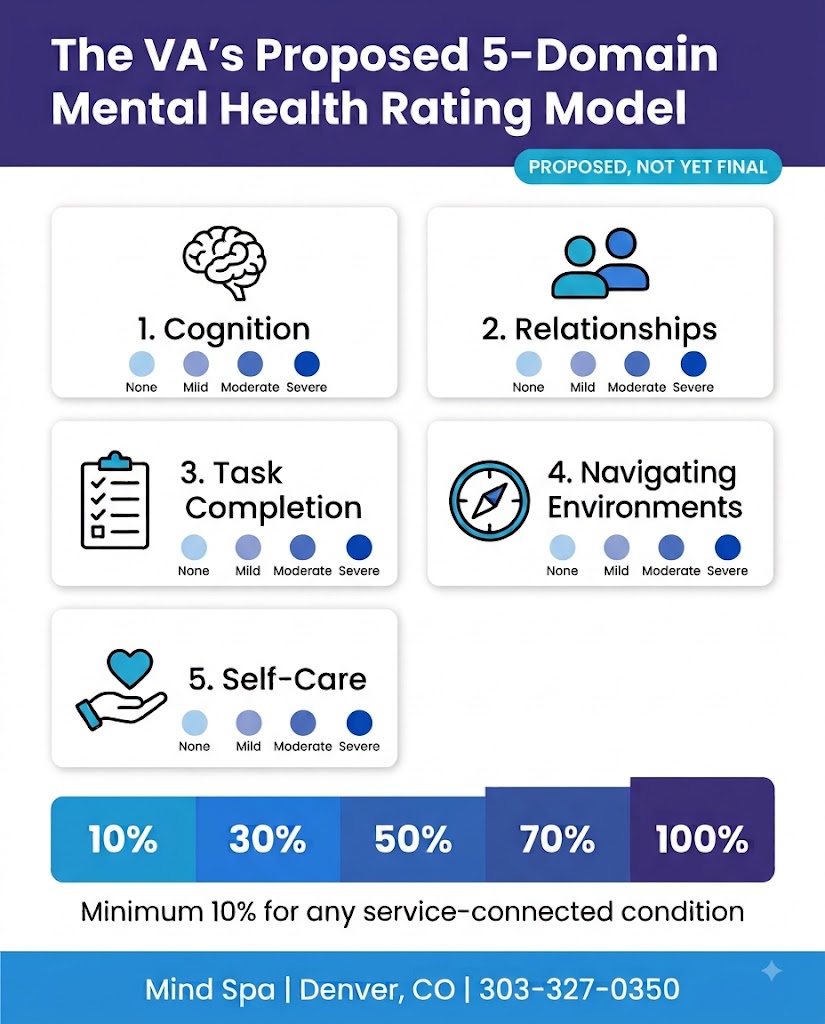
The proposed system replaces that language with a domain-based functional model. Instead of one fuzzy judgment call, examiners would score the severity and frequency of your impairment across five specific areas of life:
Each domain gets a severity level from 0 to 4. Your overall rating is then built from your worst domains, not a single global impression.
| Proposed Rating | What It Would Require |
|---|---|
| 100% | Level 4 impairment in one or more domains, or Level 3 in two or more domains |
| 70% | Level 3 impairment in one domain, or Level 2 in two or more domains |
| 50% / 30% | Intermediate levels of domain impairment, scored by severity and frequency |
| 10% minimum | Any service-connected mental health diagnosis. The 0% rating is eliminated entirely. |
Two things stand out. First, the guaranteed floor: every service-connected mental health condition would rate at least 10%. Today, a veteran can be service-connected at 0% and receive nothing. Second, the path to higher ratings gets more concrete. A veteran whose condition destroys their ability to leave the house or maintain relationships, but who technically holds a job, is chronically under-rated by the current work-centric formula. The domain model is designed to capture exactly that veteran.
Important: none of this is final. As of August 2026, the VA has not published a final rule or an effective date, and the proposal is under administration review. It could take effect late in 2026, be modified, or be delayed further. Any article telling you the new criteria are already in force is wrong.
This is the question we hear most, so here it is plainly: the VA cannot lower your existing rating just because the rating criteria changed. Veterans rated under the current system keep their ratings. The new criteria would apply to claims filed after the rule takes effect.
There is one scenario that works entirely in your favor: if your claim or appeal is pending when new criteria take effect, the VA is required to apply whichever version of the criteria produces the better result for you. Filing now does not lock you out of a more favorable future formula.
This fear keeps a lot of veterans out of treatment, and it deserves a direct answer.
Seeking treatment does not trigger a rating reduction. Reductions require a formal process: a re-examination, evidence of sustained material improvement in your condition under the ordinary conditions of life, and due process notice to you. Long-standing ratings carry additional protections. Ratings in place for five or more years cannot be reduced based on a single examination, and ratings in place for twenty years are protected from reduction absent fraud.
Now flip the frame, because this is what most articles miss. Under the proposed domain model, your treatment records become your evidence. Standardized symptom scales, documented functional impairment across cognition, relationships, task completion, and daily life, tracked over time by a treating clinic, is precisely the kind of documentation the new criteria are built to read. An untreated condition produces a thin file. A treated condition produces a documented one.
At Mind Spa we measure outcomes with standardized instruments at every stage of care. Our patients leave treatment with a clinical record that describes their actual functioning in concrete terms. That record serves your health first. It also serves your claim file, whichever rating formula is in force when it is read.
Where Mind Spa fits: We are not a claims agency and we do not file paperwork with the VA. We are an interventional psychiatry clinic that treats the conditions these ratings describe, with TMS, ketamine, hyperbaric oxygen therapy, medication management, and psychotherapy, and we document your care to clinical standards. If your depression, PTSD, anxiety, or TBI symptoms are the reason you are reading about ratings at all, treating them is the part of this we can help with.
No. As of August 2026, the changes are proposed but not final. The VA published the proposed rule in February 2022 and no effective date has been announced. Existing ratings are unaffected.
No. Veterans with existing ratings are grandfathered in. The VA cannot lower a rating simply because the rating criteria changed. New criteria would apply to claims filed after implementation.
Cognition, interpersonal interactions and relationships, task completion and life activities, navigating environments, and self-care. Each is scored 0 to 4 by severity and frequency, and the overall rating is built from the most impaired domains.
Under the proposal, yes. Every service-connected mental health condition would receive a minimum 10% rating.
Seeking treatment does not trigger a reduction. Reductions require re-examination, evidence of sustained improvement, and due process, with added protections for ratings held five or more years. Documented treatment also builds the functional evidence that supports an accurate rating.
File now. If the criteria change while your claim is pending, the VA must apply whichever version is more favorable to you. Consult a free accredited VSO representative for strategy on your specific situation.
Mind Spa treats depression, PTSD, anxiety, and TBI in veterans and first responders with Tricare, VA Community Care, and major commercial plans.
Book A ConsultOr call us directly: 303-327-0350
This article is educational and reflects the proposed rule as publicly described as of August 2026. It is not legal advice, and Mind Spa does not represent veterans in disability claims. For claim decisions, consult a VA-accredited Veterans Service Organization or attorney. Rating criteria, timelines, and protections are governed by federal regulation and may change.