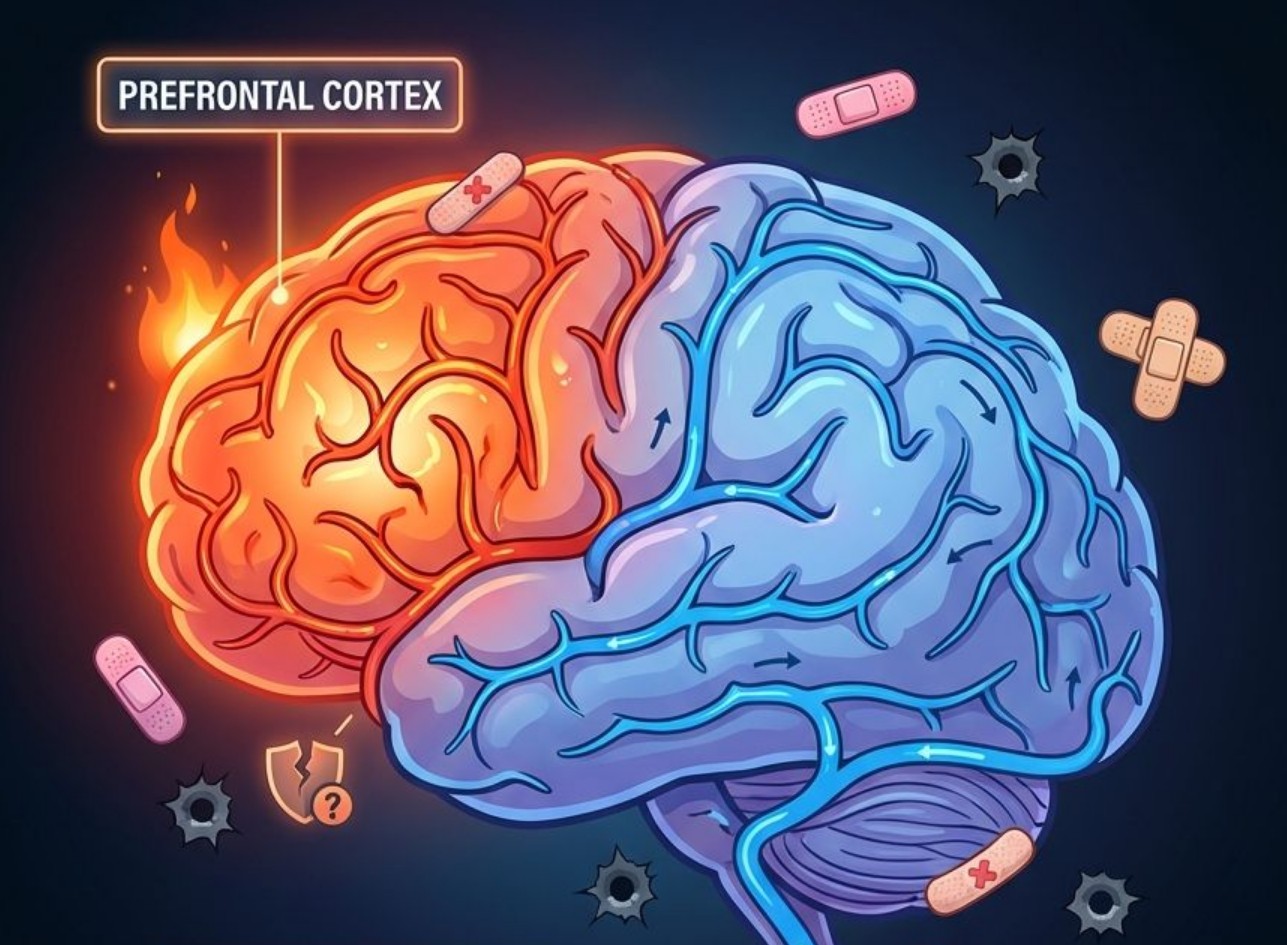
Traditional psychiatry often focuses on symptoms but misses one of the core drivers of “treatment resistance” in depression, PTSD, and TBI: chronic neuroinflammation and disrupted blood flow in critical brain networks like the prefrontal cortex. For many Veterans and first responders, that biology helps explain why medications alone so often fall short—and why they feel like the system is failing them, not the other way around.
Traumatic brain injury, even at mild levels, is now clearly linked with a long-lasting inflammatory response in the brain.
Similar inflammatory patterns appear in mood disorders: people with major depressionspecially those with treatment-resistant depression—are more likely to show elevated inflammatory markers and may represent an “inflammatory subtype” of depression.
In other words, for a large subset of patients with chronic PTSD, TBI, and depression, there is real evidence of ongoing neuroinflammation—not just “chemical imbalance” or purely psychological distress.
The idea that “inflammation shuts off blood flow to the prefrontal cortex” is a simplification, but it reflects a pattern the literature supports:
Taken together, these findings support the clinical observation that patients with chronic trauma and brain injury often experience:
So while it is not yet accurate to say inflammation literally “shuts off” blood flow in a simple on/off way, there is solid evidence that neuroinflammation, vascular dysregulation, and prefrontal dysfunction travel together in chronic PTSD, depression, and TBI.
If part of the problem is an inflammatory, vascular, and circuit-level issue, it makes sense that simply adjusting serotonin or norepinephrine is not enough for many patients.
This supports the core message of your post: many Veterans and first responders with chronic PTSD, TBI, and depression are not “failing treatment”—their treatments are failing to adequately target the biology driving their symptoms.
Emerging evidence suggests that brain-focused and neuromodulation approaches may help by influencing both circuits and inflammation.
While more research is needed, these data align with a layered strategy: address neuroinflammation and circuit function while also working with trauma, cognition, and behavior—rather than relying on medications alone.
For Veterans, first responders, and others with complex trauma histories, Mind Spa Denver’s model reflects this integrated understanding of brain health.
From this lens, “treatment-resistant” is often a mislabel. In many cases, the patient is not resistant—the approach is incomplete. A physiology-aware strategy that accounts for neuroinflammation, perfusion, and network-level disruption offers a more accurate and hopeful framework for healing.
Works Cited