


Clinical Evidence / Hyperbaric Oxygen
How Hyperbaric Oxygen Speeds Wound Healing and Surgical Recovery
In wound care, hyperbaric oxygen is not a wellness trend. It is one of the oldest evidence-based tools in medicine, cleared by the Food and Drug Administration for specific conditions. Most patients are never told it exists.
Most people file hyperbaric oxygen under wellness trends, somewhere between cold plunges and intravenous drips. That is a mistake, at least for one part of medicine. In wound care, hyperbaric oxygen therapy, meaning breathing concentrated oxygen inside a pressurized chamber, is one of the oldest evidence-based tools we have. It is cleared by the Food and Drug Administration and formally approved for specific conditions. This is not the speculative end of the field. This is standard of care.
Why some wounds refuse to close
Healing is an oxygen-hungry process. Fighting off infection takes oxygen. Building new blood vessels takes oxygen. Laying down collagen, the structural protein that closes a wound, takes oxygen.
The cruel irony is that the wounds most likely to stall are exactly the ones where blood supply, and therefore oxygen, has already failed. Think diabetic feet. Tissue damaged by radiation. Crushed limbs. Surgical flaps, meaning transplanted sections of living tissue, that are starting to die. The tissue wants to heal. It simply cannot get the fuel.
The therapy solves this with physics
When you breathe concentrated oxygen at two to three times normal atmospheric pressure, oxygen is forced to dissolve directly into your blood plasma, the liquid part of the blood, independent of red blood cells. Normally almost all your oxygen rides on hemoglobin, the oxygen-carrying protein inside red blood cells. Under pressure, so much oxygen dissolves into the plasma that it can reach tissue hemoglobin can no longer supply.
The delivery system, before and under pressure
Breathing room air
1.0 ATA
Oxygen rides on red blood cells. Where circulation has failed, the delivery truck cannot reach the site.
Inside the chamber
2.0 to 3.0 ATA
Oxygen dissolves into the plasma itself and flows where red blood cells no longer travel.
The lasting effect matters more than the session
The pressure effect ends when you leave the chamber. What the oxygen surge triggers does not.
New circulation
The surge switches on vascular endothelial growth factor, or VEGF, the signaling molecule that tells the body to grow new blood vessels. Circulation improves, so the benefit outlives the session.
Sharper infection control
Oxygen sharpens the immune system's ability to kill bacteria at the wound site, where stalled healing and infection usually travel together.
Structural repair
It drives fibroblasts, the cells that manufacture connective tissue, to rebuild the collagen scaffolding a wound needs to close.
Approved, not experimental
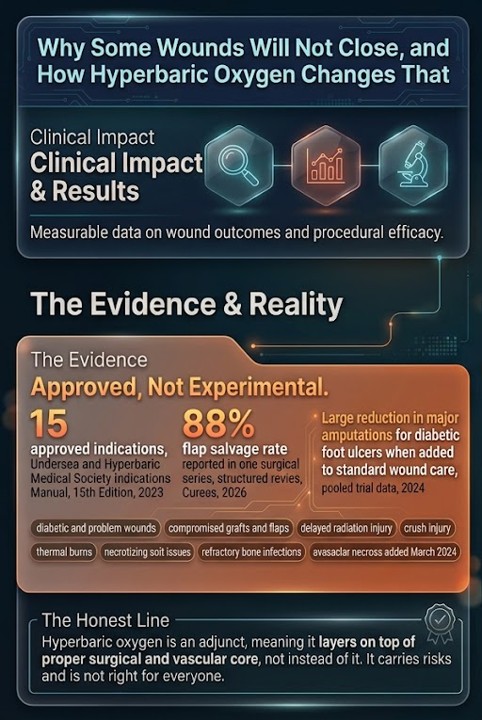
The Undersea and Hyperbaric Medical Society, the body that sets the standard for the field, lists 15 approved indications in its current manual. Among them are diabetic and other problem wounds, compromised skin grafts and flaps, delayed radiation injury, crush injury, thermal burns, necrotizing soft tissue infections, and refractory bone infections. In March 2024 the society added avascular necrosis, meaning dead bone tissue caused by lost blood supply, to that list.
- Diabetic and problem wounds
- Compromised grafts and flaps
- Delayed radiation injury
- Crush injury
- Thermal burns
- Necrotizing soft tissue infections
- Refractory bone infections
- Avascular necrosis
Look at the numbers where the data is deepest.
15
Approved indications in the current field standard, with avascular necrosis added in March 2024.
UHMS Indications Manual, 15th Edition
88%
Flap salvage rate reported in one surgical series within a structured review of tissue salvage.
Cureus, 2026
Fewer amputations
In diabetic foot ulcers, pooled trial data links the therapy, used alongside standard wound care, to higher healing rates and a large reduction in major amputations.
Diabetic foot ulcer meta-analyses, 2024
A 2025 meta-analysis also found value for hyperbaric oxygen as an adjunct in selected aesthetic surgery recovery. In reconstructive surgery more broadly, radiation tissue injury is described as one of the most established indications in the entire field.
A fair word of caution
Hyperbaric oxygen is not for every wound, and it is not a replacement for good surgical and vascular care. It is an adjunct, meaning a therapy that works best layered on top of proper wound management, not instead of it. It carries its own risks and is not appropriate for everyone.
Why this matters for veterans and first responders
Our community carries an outsized load of the exact conditions where this therapy helps. Diabetes. Orthopedic and blast trauma. Radiation exposure from cancer treatment. Complex surgical reconstruction.
When a wound stops healing in that population, the next conversation is often about amputation, and the cost in mobility, independence, and mental health is enormous.
What makes this story different from most of what we cover is that the message is not skepticism. It is access. The evidence exists. The approval exists. Too many patients are simply never told the option is on the table.
How we offer it at Mind Spa
Hyperbaric oxygen is a self-pay service at Mind Spa. We do not bill it to insurance.
We share the science anyway, because you deserve to understand a real, evidence-backed therapy and then decide, with your own care team, whether it belongs in your plan.
Managing a wound that will not close?
It is a fair question to raise. Ask your care team whether hyperbaric oxygen belongs in the plan. If you want to talk it through with ours first, we will give you a straight answer about whether it makes sense for you.
Book a free consult Or call 303-327-0350Sources
- Undersea and Hyperbaric Medical Society. Hyperbaric Medicine Indications Manual, 15th Edition, 2023. Avascular necrosis added March 2024. uhms.org
- Hyperbaric Oxygen Therapy in Surgical Wound Healing and Tissue Salvage: A Structured Narrative Review. Cureus, 2026. pmc.ncbi.nlm.nih.gov/articles/PMC13109970
- Efficacy of Hyperbaric Oxygen Therapy as an Adjunct in Aesthetic Surgery: A Systematic Review and Meta-analysis. Aesthetic Plastic Surgery, 2025. link.springer.com/article/10.1007/s00266-025-04728-9
- Hachmo Y, Hadanny A, et al. Hyperbaric oxygen therapy increases telomere length and decreases immunosenescence in isolated blood cells: a prospective trial. Aging (Albany NY), 2020. pmc.ncbi.nlm.nih.gov/articles/PMC7746357
- Hachmo Y, Hadanny A, et al. The effect of hyperbaric oxygen therapy on the pathophysiology of skin aging: a prospective clinical trial. Aging (Albany NY), 2021. pmc.ncbi.nlm.nih.gov/articles/PMC8660605
This article is for education only and is not medical advice. Hyperbaric oxygen therapy is not appropriate for everyone and carries risks. Talk with a qualified clinician about your own condition before starting any treatment. Hyperbaric oxygen therapy at Mind Spa is offered as a self-pay service and is not billed to insurance.