


Hyperbaric Oxygen Therapy
Can Hyperbaric Oxygen Actually Slow Biological Aging?
We were all taught the same story about aging. It only moves one direction. You manage it, you slow it a little with sleep and exercise, but you never move the needle backward. A group of trials out of Tel Aviv is starting to complicate that story, and the data deserves a clear-eyed look, without the longevity-industry hype that usually surrounds it.
Start with what aging actually is at the cellular level. Two of the most established markers scientists use are telomere length and cellular senescence. Telomeres are the protective caps on the ends of your chromosomes. Every time a cell divides, they get a little shorter, and short telomeres track with age-related disease. Senescent cells are the second marker. These are old cells that have stopped dividing but refuse to die. They sit in your tissue and leak inflammatory signals into everything around them. If you want a mental picture of what “getting older” looks like inside the body, it is shortening telomeres and a rising load of these inflammatory zombie cells.
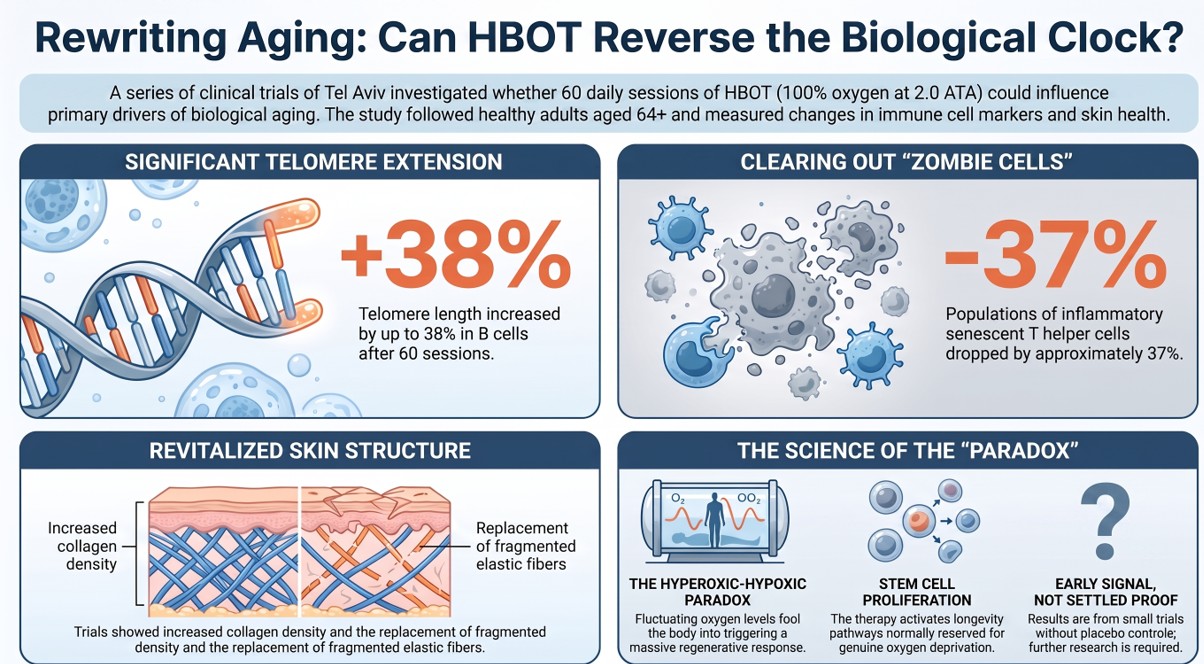
Here is what the researchers did. They took 35 healthy adults aged 64 and older, people with no cognitive or physical decline, and put them through 60 daily hyperbaric oxygen sessions over three months. Each session was 100% oxygen at two atmospheres of pressure for 90 minutes, with short air breaks built in. Then they measured those two aging markers in the participants’ immune cells.
The results went the opposite direction of normal aging. Telomere length increased significantly, by roughly 38% in B cells, about 29% in T helper cells, and around 22% in natural killer cells (Hachmo et al., Aging (Albany NY), 2020). The population of senescent T helper cells dropped by about 37%. A separate trial from the same group looked at skin and found increased collagen density, new blood vessel formation, and fragmented elastic fibers being replaced with longer, healthier ones (Hachmo et al., Aging, 2021).
The mechanism has a name, and it is worth understanding because it is counterintuitive. It is called the hyperoxic-hypoxic paradox. You flood the tissue with a high concentration of oxygen during the session, then the level drops back to normal when the session ends. The body reads that swing as a low-oxygen stress event, even though it is the opposite, and it launches a regenerative response normally reserved for genuine oxygen deprivation. That response includes stem cell proliferation, new blood vessel growth, mitochondrial repair, and the activation of longevity-associated pathways. In other words, the therapy works by fooling the body’s own repair machinery into turning on.
Now the part that keeps this honest. These trials did not have placebo control groups. The samples were small. One of the skin studies included only men. The senescence finding leaned on a single biomarker. The authors themselves list these limitations plainly. This is an early and genuinely interesting signal, not settled proof, and no responsible person should tell you that hyperbaric oxygen reverses aging or extends your lifespan. Those claims are not supported yet.
But here is why it matters for the people we work with. Veterans and first responders often carry bodies that have aged faster than the calendar says they should have. Years of physical load, blast exposure, broken sleep, and chronic inflammation add up. For that population, the idea that a measurable marker of biological aging can move at all reframes the whole conversation. Aging stops looking like a fixed sentence and starts looking like a process, at least in part.
The question is not whether we can live forever. The question is narrower and more useful. Is the pace of biological aging more changeable than we assumed? The early answer is maybe, and that alone is worth watching closely while better-controlled trials do the real work of finding out.
Questions people ask
Does hyperbaric oxygen therapy reverse aging?
No. The published trials measured changes in two biological markers of aging, telomere length and senescent cell load, in a small group of adults over 64. They did not measure lifespan, and they did not include placebo control groups. The signal is early and interesting. It is not proof that hyperbaric oxygen reverses aging or extends life.
What did the Tel Aviv hyperbaric oxygen aging study actually find?
Researchers put 35 healthy adults aged 64 and older through 60 daily hyperbaric oxygen sessions over three months at 100% oxygen and two atmospheres of pressure for 90 minutes each. Telomere length increased by roughly 38% in B cells, about 29% in T helper cells, and around 22% in natural killer cells. The population of senescent T helper cells dropped by about 37%.Hachmo et al., Aging (Albany NY), 2020
What is the hyperoxic-hypoxic paradox?
Tissue is flooded with a high concentration of oxygen during a hyperbaric session, then the level drops back to normal when the session ends. The body reads that swing as a low-oxygen stress event and launches a regenerative response normally reserved for genuine oxygen deprivation. That response is associated with stem cell proliferation, new blood vessel growth, and mitochondrial repair.
What are the limitations of the hyperbaric oxygen aging research?
The trials had no placebo control groups. The samples were small. One of the skin studies included only men. The senescence finding relied on a single biomarker. The authors list these limitations themselves. Better-controlled trials are needed before any conclusions are drawn.
Why does biological aging research matter for veterans and first responders?
Veterans and first responders often carry bodies that have aged faster than the calendar says they should have. Years of physical load, blast exposure, broken sleep, and chronic inflammation accumulate. Research showing that a measurable marker of biological aging can move at all reframes aging as a process rather than a fixed sentence.
Sources
- Hachmo Y, Hadanny A, Abu Hamed R, et al. Hyperbaric oxygen therapy increases telomere length and decreases immunosenescence in isolated blood cells: a prospective trial. Aging (Albany NY). 2020.
- Hachmo Y, Hadanny A, Mendelovic S, et al. The effect of hyperbaric oxygen therapy on the pathophysiology of skin aging: a prospective clinical trial. Aging (Albany NY). 2021.
Mind Spa runs a hard-sided hyperbaric chamber at 2.0 ATA in Greenwood Village, as part of a layered treatment model for veterans, first responders, and their families.
Book a free consult