Transcranial magnetic stimulation (TMS) has already changed the landscape for people with depression who do not respond to medications or traditional talk therapy. Accelerated theta-burst stimulation (aTBS) is now pushing that progress even further, showing that it may be possible to deliver stronger antidepressant effects in a shorter amount of time—using technology that looks a lot like the TMS we already use in clinic.
TMS is a noninvasive neuromodulation treatment that uses pulsed magnetic fields to stimulate specific regions of the brain involved in mood regulation, typically the left dorsolateral prefrontal cortex (DLPFC).
Key points about standard TMS:
For many people with major depressive disorder who have not responded to multiple medications, TMS offers a chance at meaningful symptom relief without systemic side effects. But the time commitment can be intense—multiple weeks of daily visits—and some patients remain partially or fully treatment‑resistant.
Theta-burst stimulation is a specific pattern of TMS pulses designed to mimic the brain’s natural rhythms. Instead of delivering a continuous train of pulses over several minutes, theta-burst uses very short bursts:
Intermittent theta-burst stimulation (iTBS) applied to left DLPFC has been shown to produce antidepressant effects comparable to standard 10 Hz TMS—but in a fraction of the time per session.
In clinical practice this means:
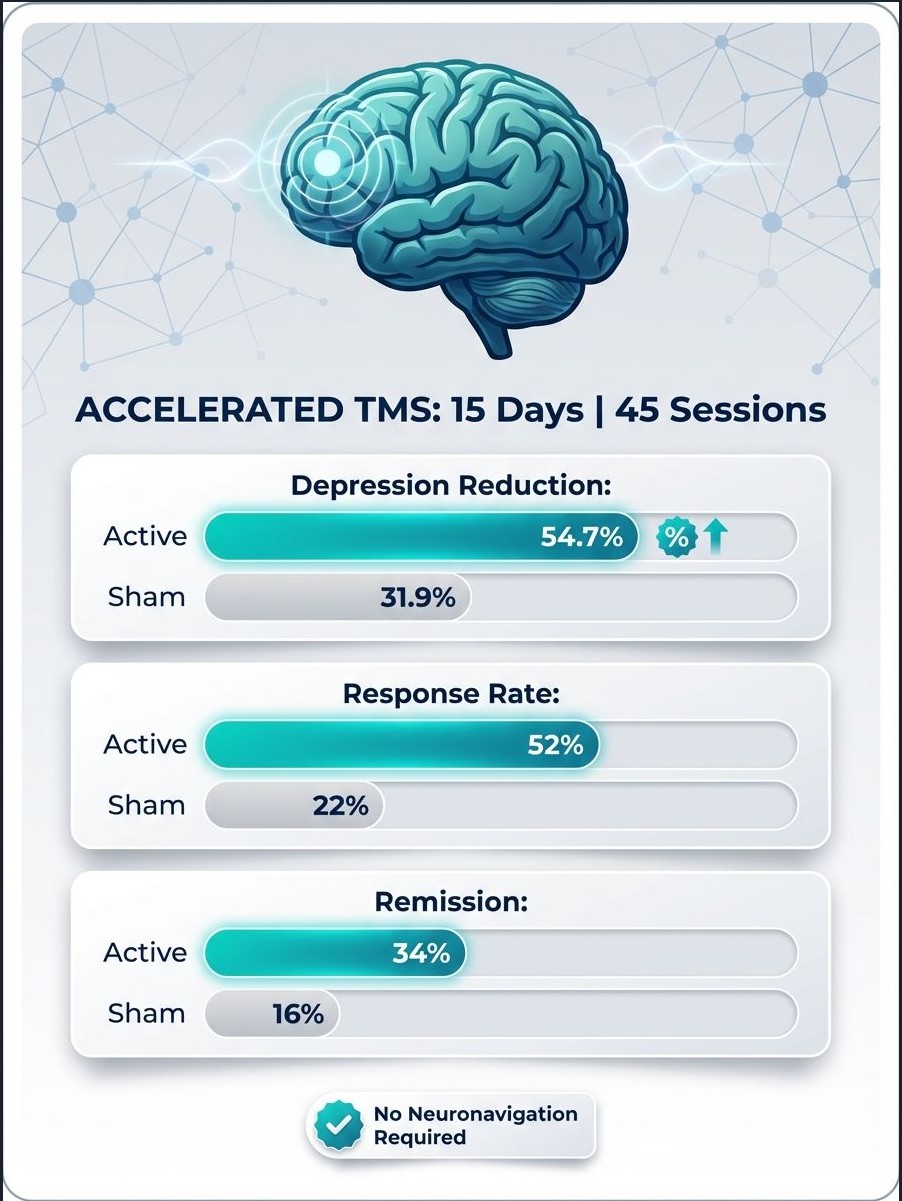
A recent randomized, triple‑blinded, sham‑controlled trial evaluated a pragmatic accelerated theta-burst stimulation (aTBS) protocol in adults with treatment‑resistant depression (TRD).
Key design features:
The “pragmatic” aspect is important. This was not a highly exotic, lab‑only protocol requiring special equipment or sophisticated imaging; the parameters were chosen to be feasible in real‑world TMS centers.
The primary outcome was change in depression severity on the Hamilton Depression Rating Scale (HDRS‑17).
Results:
Clinically important outcomes:
In other words, more than half of patients receiving accelerated TBS achieved at least a 50% reduction in depressive symptoms, and roughly one in three reached remission—even though all had treatment‑resistant depression at baseline.
Safety is a central question for any intensified neuromodulation protocol. In this trial, accelerated TBS was well tolerated:
This aligns with the broader safety profile of TMS, which has a very low risk of serious events when delivered within established guidelines.
An important part of the study looked at patients who did not respond in the sham arm. They were then offered open‑label active aTBS:
This suggests that the protocol has meaningful therapeutic potential even in patients who initially “failed” the sham condition and underscores that the effect is not just placebo.
From a clinical and operational standpoint, accelerated TBS directly addresses several real‑world barriers in treatment‑resistant depression care:
At Mind Spa Denver, the focus is on stacking evidence‑based, brain‑directed treatments to improve outcomes for people with depression, anxiety, PTSD, and traumatic brain injury. TMS is a core part of that strategy because it:
Accelerated theta-burst stimulation builds on this foundation by suggesting that:
For patients, the message is hopeful but measured: accelerated TBS is not a cure‑all, and not every patient will respond. Yet for people who have already tried multiple medications and standard therapies, this study shows that their brain is still plastic and responsive to targeted stimulation when delivered in an optimized schedule.
For individuals and families exploring options beyond traditional antidepressants, accelerated TMS and related neuromodulation strategies represent a promising new frontier—one that aligns with Mind Spa Denver’s mission to combine advanced technology, neuroscience, and compassionate care to help patients get better, faster.
Works Cited